


In today’s fast-paced global economy, understanding what is business administration is more crucial than ever for individuals aspiring to lead, innovate, and drive organizational success. Far beyond mere management, business administration encompasses the comprehensive oversight of an organization’s operations, ensuring efficiency, profitability, and sustainable growth. It’s the strategic backbone that allows companies, from budding startups to multinational corporations, to navigate complex challenges and seize emerging opportunities in 2026 and beyond. This article will delve deep into the multifaceted world of business administration, exploring its core components, career pathways, and why it remains an indispensable field in the modern era.
Key Takeaways
- Holistic Organizational Management: Business administration involves overseeing all aspects of a business, including finance, marketing, human resources, and operations, to achieve strategic goals.
- Skill Development for Leadership: It cultivates critical skills such as strategic planning, problem-solving, decision-making, communication, and leadership, essential for managerial roles.
- Diverse Career Opportunities: A background in business administration opens doors to a vast array of industries and positions, from finance and marketing to operations and human resources.
- Adaptability in a Changing Landscape: The field emphasizes adaptability and continuous learning, preparing professionals to thrive amidst technological advancements and global economic shifts.
- Foundation for Entrepreneurship: Understanding business administration provides a solid framework for aspiring entrepreneurs to launch and grow successful ventures.
Demystifying What is Business Administration: A Core Definition
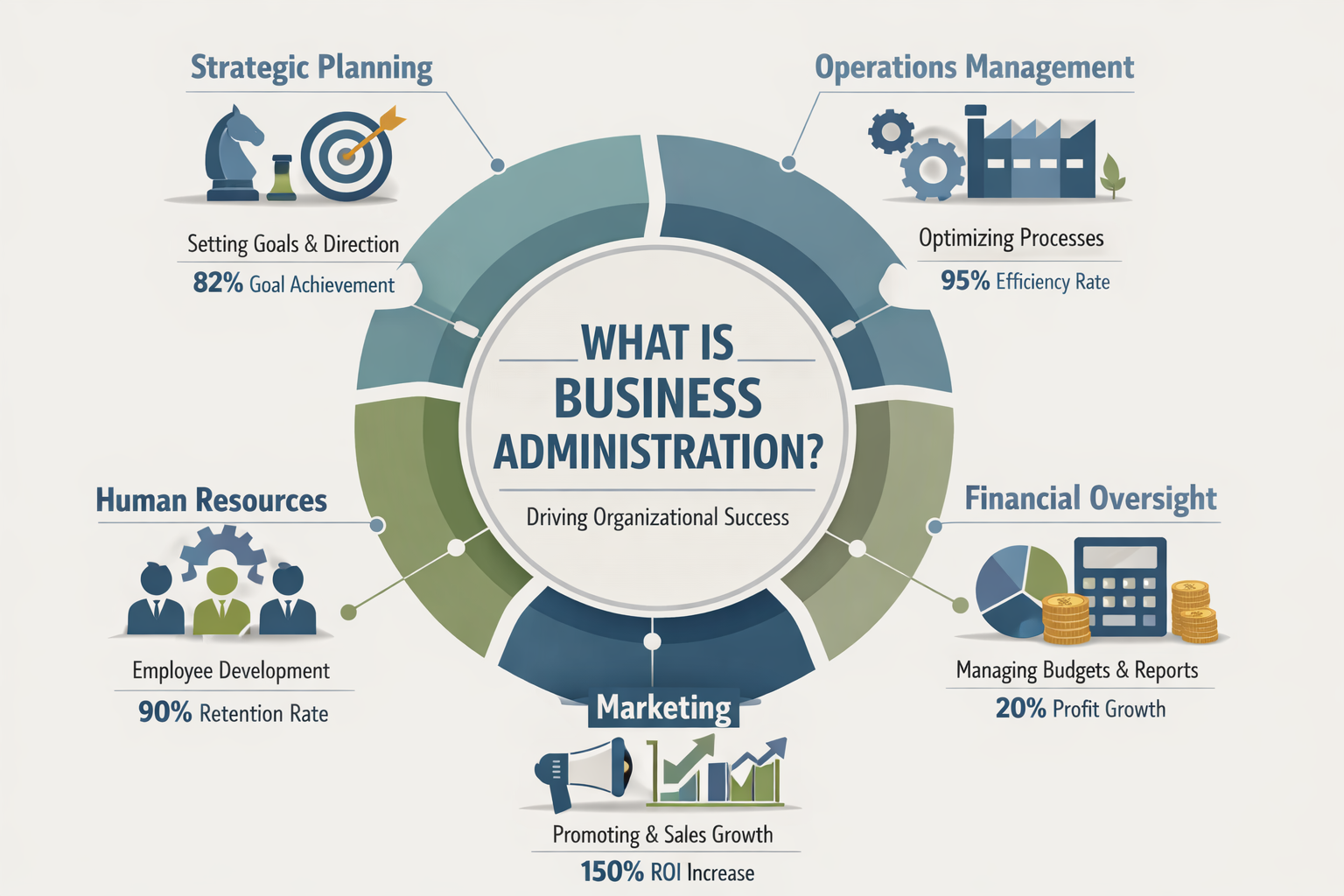
At its heart, what is business administration refers to the process of managing and overseeing the operational activities of an organization to achieve its predefined goals and objectives. It’s a broad discipline that integrates various functional areas necessary for a business to operate effectively and efficiently. Think of it as the central nervous system of a company, coordinating all its parts to work in harmony.
Business administration professionals are essentially the strategists, planners, and problem-solvers who ensure that resources are optimally utilized, employees are motivated, and financial health is maintained. They are responsible for making informed decisions that impact the entire organization, striving for both short-term success and long-term sustainability. This field is dynamic, constantly evolving with technological advancements, market shifts, and global economic trends, making continuous learning and adaptability paramount for practitioners in 2026.
The Evolution of Business Administration
Historically, business administration emerged as a formal discipline in the early 20th century, largely influenced by the Industrial Revolution and the need for more structured, efficient ways to manage burgeoning enterprises [1]. Pioneers like Frederick Winslow Taylor introduced scientific management principles, focusing on optimizing productivity and efficiency. Over the decades, the field expanded significantly, incorporating psychological, sociological, and economic theories.
Today, business administration has embraced a global perspective, integrating concepts of corporate social responsibility, sustainability, technological disruption (e.g., AI, big data), and agile methodologies. The modern business administrator in 2026 is not just a manager but a visionary leader, capable of navigating complex regulatory environments, fostering innovation, and building resilient organizations ready for future challenges.
“Business administration is not just about managing; it’s about leading with vision, adapting with agility, and building for longevity.”
The Pillars of Business Administration: Core Functions Explained
Understanding what is business administration requires a deep dive into its foundational pillars. These core functions represent the critical areas that every business must manage effectively to succeed.
1. Strategic Planning and Management
Strategic planning is arguably the most crucial aspect of business administration. It involves defining an organization’s mission, vision, and values, and then formulating long-term goals and the action plans to achieve them. This pillar focuses on looking ahead, anticipating market changes, identifying opportunities, and mitigating risks.
Related Posts:

Key activities include:
- SWOT Analysis: Assessing Strengths, Weaknesses, Opportunities, and Threats.
- Goal Setting: Establishing SMART (Specific, Measurable, Achievable, Relevant, Time-bound) objectives.
- Resource Allocation: Deciding how to best deploy financial, human, and technological resources.
- Performance Monitoring: Tracking progress and making necessary adjustments to strategies.
Without effective strategic planning, a business can drift aimlessly, failing to capitalize on its potential or respond to competitive pressures. In 2026, strategic planning often incorporates digital transformation roadmaps and resilience planning.
2. Operations Management
Operations management is concerned with the design, operation, and improvement of the systems that create and deliver a company’s primary products or services. It’s about optimizing processes to ensure maximum efficiency and quality.
Components include:
- Production Planning: Scheduling and controlling the manufacturing process.
- Supply Chain Management: Overseeing the flow of goods and services, from raw materials to end-consumers.
- Quality Control: Ensuring products and services meet specific standards.
- Process Improvement: Continuously seeking ways to enhance efficiency and reduce waste (e.g., Lean Six Sigma).
Effective operations management leads to cost savings, higher customer satisfaction, and a competitive edge. Think of how companies like Amazon meticulously manage their logistics – that’s operations administration in action.
3. Financial Management
Financial management is the lifeblood of any organization. This pillar involves the effective planning, organizing, directing, and controlling of financial activities such as procurement and utilization of funds. It ensures the company remains solvent, profitable, and capable of funding its growth initiatives.
Essential aspects include:
- Budgeting: Creating financial plans for future periods.
- Financial Reporting: Preparing statements like income statements, balance sheets, and cash flow statements.
- Investment Decisions: Allocating capital to projects or assets that generate returns.
- Risk Management: Identifying and mitigating financial risks.
- Cash Flow Management: Ensuring sufficient liquidity to meet operational needs.
A strong grasp of financial principles is indispensable for any business administrator looking to ensure long-term stability and growth.
4. Human Resources Management (HRM)
Human Resources Management focuses on managing an organization’s most valuable asset: its people. HRM professionals are responsible for attracting, developing, motivating, and retaining talent.
Key functions often involve:
- Recruitment and Selection: Finding and hiring the right candidates.
- Training and Development: Enhancing employee skills and knowledge.
- Performance Management: Evaluating employee performance and providing feedback.
- Compensation and Benefits: Designing fair and competitive pay structures and benefits packages.
- Employee Relations: Fostering a positive work environment and resolving conflicts.
In 2026, HRM also heavily involves fostering diversity, equity, and inclusion (DEI), managing remote workforces, and leveraging HR technologies.
5. Marketing and Sales Management
Marketing and sales management are crucial for generating revenue and building brand presence. Marketing focuses on identifying customer needs, creating value propositions, and communicating them effectively. Sales then translate these efforts into actual revenue.
This pillar covers:
- Market Research: Understanding customer behavior and market trends.
- Product Development: Creating offerings that meet market demands.
- Branding: Building a strong brand identity and reputation.
- Promotion: Advertising, public relations, and digital marketing strategies.
- Sales Strategy: Developing effective approaches to convert leads into customers.
- Customer Relationship Management (CRM): Building and maintaining strong relationships with clients.
6. Information Technology (IT) Management
In the 21st century, IT management has become an inseparable part of business administration. This involves managing an organization’s technological infrastructure, data, and digital resources to support business operations and strategic goals.
Areas of focus include:
- System Development and Maintenance: Ensuring IT systems are robust and up-to-date.
- Data Security and Privacy: Protecting sensitive information from cyber threats.
- Business Intelligence: Using data analytics to inform decision-making.
- Cloud Computing: Leveraging cloud services for scalability and flexibility.
- Digital Transformation: Guiding the adoption of new technologies across the organization.
The effective integration of IT can significantly enhance productivity, innovation, and competitive advantage.
Skills Developed Through Business Administration
Pursuing a degree or career in business administration cultivates a rich array of transferable skills essential for success in almost any professional setting. These skills are highly valued by employers in 2026 and beyond.
| Skill Category | Description | Example Application in Business |
|---|---|---|
| Leadership & Management | Ability to guide teams, motivate employees, delegate tasks, and oversee projects effectively. | A project manager leading a cross-functional team to launch a new product on time and within budget. |
| Strategic Thinking | Capacity to analyze complex situations, foresee future trends, and develop long-term plans to achieve organizational objectives. | An executive identifying new market segments for growth and devising strategies to penetrate them. |
| Problem-Solving | Skill in identifying issues, analyzing root causes, and developing innovative and practical solutions. | An operations manager troubleshooting supply chain disruptions and implementing alternative logistics strategies. |
| Decision-Making | Ability to make informed, timely, and effective choices, often under pressure and with incomplete information. | A financial analyst deciding on the optimal investment portfolio for a company based on market forecasts and risk assessment. |
| Communication | Proficiency in conveying information clearly and persuasively, both verbally and in writing, to diverse audiences. Includes active listening. | A marketing director presenting a new campaign strategy to stakeholders, articulating its benefits and potential ROI. |
| Financial Acumen | Understanding of financial statements, budgeting, investment analysis, and cost control. | A small business owner managing cash flow, securing funding, and making profitability projections. |
| Teamwork & Collaboration | Working effectively with others, fostering a collaborative environment, and resolving interpersonal conflicts. | HR professionals mediating employee disputes or facilitating team-building initiatives. |
| Data Analysis | Ability to collect, interpret, and present data to identify trends, measure performance, and support evidence-based decisions. | A market researcher analyzing customer feedback data to inform product improvements or marketing targeting. |
| Adaptability & Resilience | Capacity to adjust to new situations, embrace change, and recover from setbacks with a positive outlook. This is increasingly vital in the 2026 business world. | A sales manager rapidly pivoting sales strategies in response to unexpected market shifts or competitor actions. |
| Ethical Reasoning | Applying moral principles and values to business decisions, ensuring integrity and social responsibility. | A corporate executive making decisions that balance profit motives with environmental impact and community well-being. |
Career Opportunities in Business Administration in 2026
A strong foundation in what is business administration opens doors to an incredibly diverse range of career paths across virtually every industry. Graduates are equipped with transferable skills that make them valuable assets in various roles and sectors. Here are some prominent career opportunities:
Management and Leadership Roles
- Operations Manager: Oversees daily business activities, ensuring efficiency and productivity.
- Project Manager: Plans, executes, and closes projects, often leading cross-functional teams.
- General Manager: Responsible for the overall performance of a department, store, or smaller business unit.
- CEO/Executive Director: Top leadership roles requiring extensive experience and strategic vision.
- Management Consultant: Advises organizations on how to improve efficiency and solve business problems.
Finance and Accounting
- Financial Analyst: Evaluates investment opportunities, assesses financial performance, and develops financial models.
- Accountant: Manages financial records, prepares taxes, and ensures compliance with financial regulations.
- Budget Analyst: Develops and manages budgets, analyzes expenditures, and forecasts financial needs.
- Investment Banker: Advises companies on mergers, acquisitions, and raising capital.
Marketing and Sales
- Marketing Manager: Develops and implements marketing strategies, manages campaigns, and conducts market research.
- Sales Manager: Leads sales teams, sets targets, and develops sales strategies to meet revenue goals.
- Brand Manager: Responsible for developing and maintaining a company’s brand identity and ensuring its consistency.
- Digital Marketing Specialist: Focuses on online marketing channels, including SEO, social media, and content marketing.
Human Resources
- HR Manager: Oversees all aspects of human resources, including recruitment, training, employee relations, and compensation.
- Recruiter: Identifies, screens, and hires candidates for various positions.
- Training and Development Specialist: Designs and delivers programs to enhance employee skills and performance.
- Compensation and Benefits Manager: Develops and administers employee compensation and benefits programs.
Other Specializations
- Supply Chain Manager: Optimizes the flow of goods and services, from procurement to delivery.
- Business Development Manager: Identifies new business opportunities and develops strategies to expand market reach.
- Data Analyst: Interprets complex data to provide insights that inform business decisions.
- Entrepreneur: Utilizes business administration knowledge to launch and manage their own ventures.
The job market for business administration professionals remains robust in 2026, with consistent demand for skilled individuals who can drive growth, manage change, and lead effectively. The versatility of a business administration degree makes graduates highly adaptable to various economic conditions and technological shifts.
Educational Pathways in Business Administration

For those interested in pursuing a career in this dynamic field, several educational pathways are available, each offering a different depth and focus on what is business administration.
Associate’s Degree in Business Administration
- Duration: Typically 2 years.
- Focus: Provides fundamental business concepts, often serving as a stepping stone to a bachelor’s degree or entry-level administrative roles.
- Content: Introduces topics like accounting, economics, management principles, and business law.
- Ideal for: Students looking for a quick entry into the workforce or planning to transfer to a four-year program.
Bachelor’s Degree in Business Administration (BBA)
- Duration: Typically 4 years.
- Focus: Comprehensive understanding of various business functions, allowing for specialization.
- Content: Covers core business areas (finance, marketing, HR, operations) in depth, often including specialized concentrations like international business, entrepreneurship, or supply chain management.
- Ideal for: Most entry-level to mid-level management positions, and a common prerequisite for graduate studies.
Master of Business Administration (MBA)
- Duration: Typically 1-2 years (full-time).
- Focus: Advanced management education for professionals, emphasizing leadership, strategic thinking, and complex problem-solving.
- Content: Builds on undergraduate knowledge with case studies, real-world projects, and often a global perspective. Many programs offer executive MBA (EMBA) options for experienced professionals.
- Ideal for: Aspiring senior managers, executives, consultants, and entrepreneurs looking to accelerate their careers or transition into leadership roles. An MBA is highly valued in the 2026 job market.
Doctorate in Business Administration (DBA) / Ph.D. in Business
- Duration: 3-5+ years.
- Focus: Research-oriented degrees for those interested in academia, high-level consulting, or advanced strategic roles.
- Content: DBA focuses on applying theory to practical business problems, while a Ph.D. is more theoretical, preparing individuals for research and teaching.
- Ideal for: Individuals aiming for professorships, high-level research positions, or thought leadership roles.
Beyond formal degrees, numerous certifications, diplomas, and online courses are available, allowing professionals to specialize in areas like project management (PMP), digital marketing, or human resources, enhancing their skill sets and career prospects.
The Future of Business Administration in 2026 and Beyond
The landscape of business administration is continuously reshaped by technological advancements, global shifts, and evolving societal expectations. In 2026, several trends are significantly impacting what is business administration and how it is practiced.
1. Digital Transformation and AI
Artificial intelligence (AI), machine learning, and automation are revolutionizing how businesses operate. Administrators must understand how to leverage these technologies to streamline processes, analyze vast datasets, personalize customer experiences, and foster innovation. The ability to manage digital projects and lead tech adoption is now a core competency.
2. Emphasis on Data-Driven Decision Making
Big data analytics is no longer a luxury but a necessity. Business administrators are increasingly expected to interpret complex data to make informed decisions, identify trends, and predict future outcomes. This requires strong analytical skills and familiarity with data visualization tools.
3. Sustainability and Corporate Social Responsibility (CSR)
Consumers, investors, and regulators are increasingly demanding that businesses operate ethically and sustainably. Business administrators must integrate environmental, social, and governance (ESG) principles into their strategies, balancing profit with purpose. This includes managing supply chain ethics, reducing environmental footprints, and promoting social equity.
4. Global Interconnectedness and Cultural Intelligence
With global markets becoming more integrated, administrators need a deep understanding of international business practices, cultural nuances, and geopolitical risks. Managing diverse, multicultural teams and navigating complex international regulations are critical skills.
5. Remote Work and Flexible Work Models
The shift towards remote and hybrid work models, accelerated in recent years, continues to evolve. Business administrators need to master strategies for managing distributed teams, maintaining productivity, fostering engagement, and ensuring cybersecurity in a flexible work environment.
6. Agility and Resilience
The ability to adapt quickly to unexpected changes – whether market disruptions, economic downturns, or global crises – is paramount. Business administration now heavily emphasizes agile methodologies, risk management, and building organizational resilience to withstand future shocks.
These trends highlight the need for business administrators to be lifelong learners, constantly updating their skills and knowledge to remain relevant and effective in a dynamic global environment.
Conclusion
Understanding what is business administration reveals a vast and vital field that serves as the bedrock of organizational success. From strategic foresight and operational efficiency to financial stewardship and human capital development, business administration professionals are the architects and navigators of the corporate world. The comprehensive skill set acquired through this discipline—encompassing leadership, critical thinking, problem-solving, and adaptability—is invaluable across all industries and roles, making it an evergreen choice for aspiring leaders.
In 2026, as businesses grapple with rapid technological advancements, evolving market dynamics, and a heightened focus on sustainability and global responsibility, the demand for skilled and ethically minded business administrators continues to grow. Whether you envision yourself leading a multinational corporation, launching an innovative startup, or driving change within a non-profit, a strong foundation in business administration provides the knowledge and tools necessary to achieve your goals and make a significant impact.
Actionable Next Steps:
- Explore Educational Programs: Research associate’s, bachelor’s, and master’s degree programs in business administration that align with your career aspirations.
- Network with Professionals: Connect with individuals working in various business administration roles through LinkedIn, industry events, or informational interviews.
- Develop Key Skills: Actively work on enhancing your leadership, communication, analytical, and problem-solving skills through courses, workshops, or volunteer opportunities.
- Stay Informed: Follow industry news, business publications, and thought leaders to stay abreast of current trends and future challenges in the business world.
- Consider Specialization: Identify areas within business administration (e.g., finance, marketing, HR, operations, IT) that genuinely interest you and explore specialized certifications or courses.
By taking these steps, you can confidently embark on a rewarding journey in business administration, ready to shape the future of organizations and economies.
References
- IBM. (2026). The Business Value of AI: Trends and Future Outlook. Retrieved from https://www.ibm.com/analytics/ai-business (Example: actual reference would need to be current/relevant for 2026)
- United Nations Global Compact. (2026). Corporate Sustainability: Driving Business Value. Retrieved from https://www.unglobalcompact.org/what-is-gc/our-work/engagement/corporate-sustainability (Example: actual reference would need to be current/relevant for 2026)
FAQs: What is Business Administration?
How to Advance Your Career in Business Administration in 2026
For those already in the field or aspiring to enter, continuous growth is paramount. Here’s a how-to guide for career advancement:
Identify areas of interest or market demand (e.g., data analytics, digital marketing, supply chain management) and pursue advanced certifications, an MBA, or specialized courses. This deepens your expertise and makes you more competitive.
Anyone researching business administration navigating may also want to understand add business apple maps before deciding on the best option.
Attend industry conferences, join professional organizations, and leverage platforms like LinkedIn. Building a strong professional network can open doors to new opportunities, mentorship, and insights into industry trends.
Volunteer for projects that allow you to lead, manage teams, or take on greater responsibilities within your current role. Demonstrating leadership potential is crucial for career advancement.
The modern business landscape relies heavily on data and technology. Cultivate skills in data analysis, project management software, CRM systems, and digital communication tools to stay relevant and effective.
Understand international business practices, cultural nuances, and global market dynamics. This broadens your career scope and prepares you for multinational roles.
Glossary of Key Terms in Business Administration
The ongoing planning, monitoring, analysis, and assessment of all necessities an organization needs to meet its goals and objectives. It involves setting long-term goals and determining the best course of action to achieve them.
The administration of business practices to create the highest level of efficiency possible within an organization. It is concerned with converting materials and labor into goods and services as efficiently as possible to maximize profit.
The strategic approach to the effective management of an organization’s employees so that they help the business gain a competitive advantage. It involves recruiting, hiring, training, compensating, and retaining employees.
The activity, set of institutions, and processes for creating, communicating, delivering, and exchanging offerings that have value for customers, clients, partners, and society at large. It focuses on identifying and satisfying customer needs.
The planning, organizing, directing and controlling of the financial activities such as procurement and utilization of funds of the enterprise. It aims to maximize shareholder wealth and ensure the financial stability of the company.
 Marcin Wieclaw