

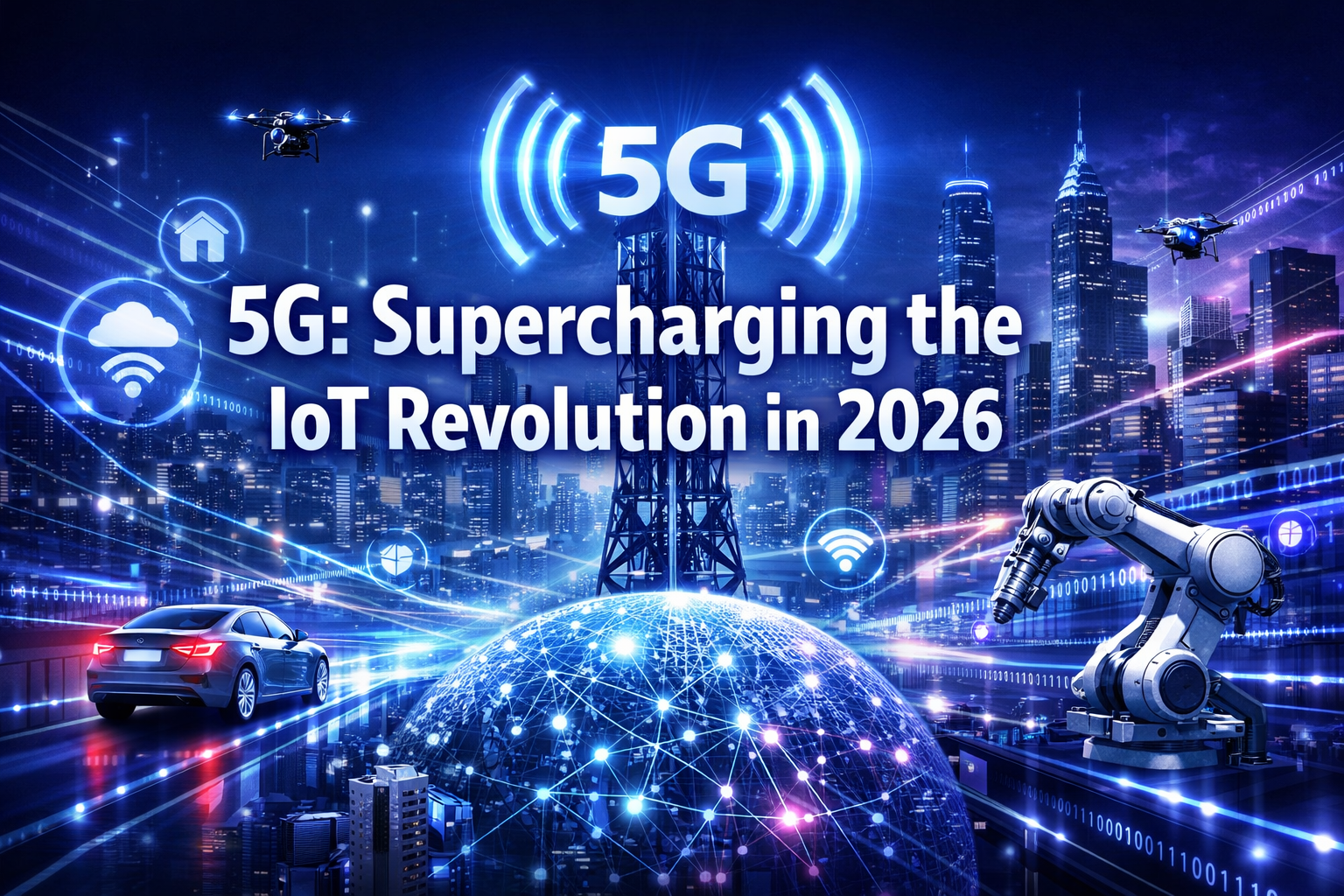
How Does 5G Technology Enhance the IoT? A Deep Dive into the Future of Connectivity
The world around us is becoming increasingly connected, a phenomenon largely driven by the Internet of Things (IoT). From smart homes to intelligent factories, IoT devices are generating vast amounts of data, promising unprecedented insights and automation. However, the true potential of this interconnected web has, until recently, been somewhat constrained by existing network capabilities. Enter 5G: the fifth generation of cellular technology, poised to revolutionize how IoT devices communicate and operate. This article will explore in depth how 5G technology enhances the IoT, unlocking new possibilities and accelerating the digital transformation across industries in 2026 and beyond.
Key Takeaways
- Unprecedented Speed and Bandwidth: 5G offers significantly faster data transfer speeds (up to 10 Gbps) and much higher bandwidth compared to previous generations, enabling rapid processing and transmission of massive IoT data streams.
- Ultra-Low Latency: With latency as low as 1 millisecond, 5G allows for near real-time communication between IoT devices, critical for applications requiring immediate responses like autonomous vehicles and remote surgery.
- Massive Device Connectivity: 5G networks are designed to support a far greater density of connected devices (up to 1 million devices per square kilometer), making large-scale IoT deployments feasible and efficient.
- Enhanced Reliability and Security: 5G introduces advanced features like network slicing and stricter security protocols, providing more reliable and secure connections for sensitive IoT applications.
- New Application Opportunities: The combined capabilities of 5G will enable a new generation of IoT applications, from highly precise industrial automation to immersive augmented reality experiences for field workers.
The Foundation of a Smarter Future: Understanding 5G and IoT
Before delving into the enhancements, it’s crucial to understand the core components.
What is the Internet of Things (IoT)?
The Internet of Things refers to a network of physical objects embedded with sensors, software, and other technologies for the purpose of connecting and exchanging data with other devices and systems over the internet [1]. These “things” can range from everyday household objects to industrial machinery, all gathering data and performing actions based on that information. The goal of IoT is to create a seamless, intelligent environment where devices can communicate and automate tasks without direct human intervention, leading to increased efficiency, convenience, and new service models.
What is 5G Technology?
5G is the latest global wireless standard after 1G, 2G, 3G, and 4G networks. It’s designed to connect virtually everyone and everything together including machines, objects, and devices [2]. More than just faster mobile internet, 5G introduces several fundamental improvements over 4G LTE, including:
- Higher Bandwidth: The capacity to carry more data simultaneously.
- Lower Latency: The time it takes for data to travel from its source to its destination and back.
- Massive Machine-Type Communications (mMTC): The ability to connect a vast number of low-power, low-cost devices.
- Enhanced Mobile Broadband (eMBB): Faster speeds for traditional smartphone use.
- Ultra-Reliable Low-Latency Communications (URLLC): Highly dependable connections with minimal delay, crucial for critical applications.
These characteristics collectively set the stage for understanding how 5G technology enhances the IoT in transformative ways.
Unpacking the Core Enhancements: How Does 5G Technology Enhance the IoT?
The convergence of 5G and IoT is not merely an incremental upgrade; it represents a paradigm shift. Let’s explore the key areas where 5G makes a profound impact.
1. Blazing Fast Speeds and Massive Bandwidth
One of the most immediate and impactful benefits of 5G for IoT is its incredible speed and bandwidth. While 4G LTE offers peak speeds of hundreds of megabits per second (Mbps), 5G can deliver speeds up to 10 gigabits per second (Gbps) [3].
Impact on IoT:
- Real-time Data Processing: IoT devices often generate enormous volumes of data, especially in scenarios like video surveillance, autonomous vehicles, or industrial sensor arrays. 5G’s high bandwidth allows this data to be transmitted to cloud or edge computing platforms much faster, enabling near real-time analysis and decision-making. Imagine a smart city where thousands of cameras and sensors are constantly feeding data about traffic, air quality, and public safety; 5G makes processing this influx of information manageable.
- Rich Media and High-Resolution Streaming: Applications requiring high-definition video feeds, such as remote inspections or telemedicine, become far more practical. For instance, in manufacturing, high-resolution cameras on robotic arms can stream video for quality control with negligible delay, improving precision and identifying defects instantly.
- Edge Computing Synergy: 5G’s speed complements edge computing by allowing data to be processed closer to its source before being sent to the cloud. This reduces backhaul traffic and latency, further accelerating decision-making.
2. Ultra-Low Latency for Critical Applications
Latency, the delay between sending and receiving data, is a critical factor for many IoT applications. 5G promises latency as low as 1 millisecond (ms), a significant improvement over 4G’s typical 50-100 ms [4].
Related Posts:



Impact on IoT:
- Autonomous Systems: For self-driving cars, drones, and robots, a millisecond delay can mean the difference between a safe operation and an accident. Ultra-low latency ensures that these systems can react to their environment instantaneously, making real-time command and control feasible.
- Remote Control and Teleoperation: Imagine a surgeon performing a delicate operation using robotic instruments from thousands of miles away. This becomes possible with 5G’s minimal latency, where the delay in tactile feedback and visual input is imperceptible to the human operator. Similarly, operating heavy machinery in dangerous environments remotely becomes safer and more efficient.
- Industrial Automation: In smart factories, precise synchronization of machines is vital. 5G’s low latency allows for deterministic communication, ensuring that different components of an assembly line can work in perfect harmony, leading to higher efficiency and fewer errors. Learn more about how solar flares affect technology and the importance of reliable networks for such critical infrastructure.
🗣
️ “The convergence of 5G’s ultra-low latency with IoT devices will unlock entirely new categories of mission-critical applications, transforming industries from healthcare to manufacturing.”
3. Massive Device Connectivity (mMTC)
The sheer number of devices expected to be connected to the IoT is staggering. Current estimates suggest tens of billions of devices will be online by 2030 [5]. Older networks struggle to handle such density without performance degradation. 5G, with its Massive Machine-Type Communications (mMTC) capabilities, is designed precisely for this challenge, supporting up to 1 million devices per square kilometer.
Impact on IoT:
- Smart Cities: From countless streetlights and parking sensors to environmental monitors and waste bins, a smart city relies on a dense network of connected objects. 5G makes it possible to connect and manage all these devices efficiently, gathering comprehensive data to improve urban living.
- Smart Agriculture: Large farms can deploy thousands of sensors to monitor soil moisture, crop health, and livestock location. 5G enables this extensive sensor network, allowing for precision agriculture that optimizes resource use and increases yields.
- Logistics and Supply Chain: Tracking every single item in a vast warehouse or shipping container fleet becomes feasible. 5G can support millions of low-power, low-cost sensors on individual packages, providing unprecedented visibility into the supply chain.
4. Enhanced Reliability and Security
For many IoT applications, especially those in critical infrastructure or healthcare, reliability and security are non-negotiable. 5G introduces several features that significantly improve these aspects.
Impact on IoT:
- Network Slicing: This innovative 5G feature allows network operators to create multiple virtual networks on a single physical infrastructure, each tailored to specific requirements. For instance, an IoT application requiring ultra-low latency and high reliability (like an ambulance communication system) can be allocated a dedicated “slice” with guaranteed performance, isolated from other traffic. This ensures critical services are never compromised by network congestion.
- Improved Security Protocols: 5G incorporates stronger encryption and authentication mechanisms compared to its predecessors. Features like enhanced subscriber privacy and improved network access security help protect IoT devices from cyber threats. Understanding what is 2G cellular technology highlights the evolution of these security measures.
- Robust Connectivity in Challenging Environments: 5G’s ability to utilize different spectrum bands (low, mid, and high-band) allows for more robust coverage, including penetration into buildings and coverage in remote areas, crucial for distributed IoT deployments.
5. Energy Efficiency for Prolonged Device Life
Many IoT devices are battery-powered and expected to operate for years without maintenance. While 5G is often associated with high power consumption for high speeds, its mMTC features are optimized for energy efficiency.
Impact on IoT:
- Extended Battery Life: Technologies like Power Saving Mode (PSM) and Extended Discontinuous Reception (eDRX) allow IoT devices to ‘sleep’ for extended periods, only waking up to transmit small packets of data. This significantly prolongs battery life, making it feasible to deploy sensors in remote or inaccessible locations for years.
- Low-Cost Devices: The design of 5G for mMTC also enables the creation of simpler, lower-cost IoT modules, reducing the overall expense of large-scale deployments.
Transformative Applications: How Does 5G Technology Enhance the IoT in Practice?
The theoretical benefits of 5G translate into tangible advancements across numerous sectors.
Smart Manufacturing and Industry 4.0
The factory floor is ripe for 5G-enabled IoT transformation.
- Predictive Maintenance: Sensors on machinery can transmit vast amounts of operational data via 5G, enabling AI algorithms to predict equipment failures before they occur, reducing downtime and maintenance costs.
- Automated Guided Vehicles (AGVs) and Robots: 5G’s low latency ensures seamless, real-time control and coordination of autonomous robots, improving efficiency and safety in logistics and assembly.
- Augmented Reality (AR) for Workers: Field technicians can use AR glasses connected via 5G to overlay digital instructions or remote expert guidance onto physical equipment, improving accuracy and reducing training time. This is a prime example of how technology helps doctors improving patient care in a different context, but the principles of remote assistance are similar.
Healthcare: Remote Care and Smart Hospitals
Healthcare stands to gain immensely from 5G-enhanced IoT.
- Remote Patient Monitoring: Wearable sensors can continuously transmit vital signs to healthcare providers over 5G, allowing for proactive intervention and reducing hospital readmissions.
- Telemedicine and Remote Surgery: High-definition video consultations and even remote-controlled surgical procedures become more viable with 5G’s reliable, low-latency connectivity.
- Asset Tracking: Hospitals can track critical equipment and even patients in real-time using 5G-connected IoT devices, improving operational efficiency and patient safety.
Autonomous Vehicles and Transportation
The dream of fully autonomous vehicles hinges on 5G.
- Vehicle-to-Everything (V2X) Communication: 5G enables cars to communicate with each other (V2V), with traffic infrastructure (V2I), pedestrians (V2P), and the network (V2N) in real-time. This exchange of data, including speed, location, and road conditions, is crucial for collision avoidance and traffic flow optimization.
- High-Definition Mapping and Navigation: Real-time updates to high-definition maps via 5G ensure autonomous vehicles always have the most accurate environmental data.
- Traffic Management: Smart traffic lights and sensors connected by 5G can dynamically adjust to traffic conditions, reducing congestion and emissions in smart cities.
Smart Cities and Urban Development
5G is the backbone of the truly smart city envisioned for 2026.
- Environmental Monitoring: A dense network of 5G-connected sensors can monitor air quality, water levels, noise pollution, and waste levels, providing data for effective urban planning.
- Intelligent Public Safety: Real-time video feeds from public cameras, coupled with IoT sensors, can provide emergency services with critical information for faster response times.
- Smart Utilities: Connected smart grids can optimize energy distribution, detect outages instantly, and integrate renewable energy sources more effectively. This connects to broader discussions about what are the roles of technology in society and how it shapes infrastructure.
Retail and Logistics
The supply chain gains unprecedented visibility and efficiency.
- Inventory Management: IoT sensors and RFID tags connected by 5G can provide real-time inventory tracking, minimizing stockouts and waste.
- Customer Experience: Smart stores can use 5G-enabled IoT to offer personalized promotions, track customer movement for store optimization, and enhance immersive shopping experiences.
- Cold Chain Monitoring: For perishable goods, 5G-connected sensors can continuously monitor temperature and humidity throughout transport, ensuring product quality and compliance.
Challenges and Considerations for 5G and IoT Integration
While the future looks promising, integrating 5G with IoT is not without its challenges.
- Infrastructure Rollout: Deploying 5G infrastructure, especially in rural areas, requires significant investment and time. Dense urban areas are often prioritized first.
- Security Vulnerabilities: While 5G offers enhanced security, the sheer number of connected IoT devices expands the attack surface. Robust cybersecurity measures and device-level security remain paramount. Understanding what is a domain in information technology is crucial for managing these complex network environments securely.
- Interoperability: Ensuring seamless communication between diverse IoT devices from different manufacturers, using various protocols, remains a complex task.
- Data Management: The exponential growth of data generated by 5G-enabled IoT devices presents challenges in terms of storage, processing, and analysis. Effective data governance and analytics platforms are essential.
- Regulatory Frameworks: Policies and regulations around data privacy, spectrum allocation, and IoT device standards need to evolve to keep pace with technological advancements.
The Road Ahead: The Future of 5G and IoT in 2026 and Beyond
As 2026 progresses, the synergy between 5G and IoT will only deepen. We are at the cusp of an era where virtually everything will be connected, intelligent, and responsive. Further advancements in 5G, such as Release 17 and upcoming releases, will continue to refine its capabilities, further optimizing it for various IoT use cases. Edge computing will become even more integral, pushing processing power closer to the data source and minimizing reliance on centralized cloud infrastructure. AI and machine learning will increasingly leverage the vast datasets generated by 5G-enabled IoT, leading to more sophisticated automation, predictive analytics, and personalized services.
The potential impact spans every facet of life and industry, promising a future of unprecedented efficiency, convenience, and innovation. Businesses and governments that embrace this convergence will be at the forefront of the next technological revolution. It’s an exciting time to witness what is information technology evolve and reshape our world.
Conclusion
The question “how does 5G technology enhance the IoT?” is answered by a multi-faceted transformation spanning speed, latency, connectivity density, reliability, and energy efficiency. 5G is not just a faster network; it is the foundational layer upon which the next generation of intelligent, interconnected IoT applications will be built. From enabling fully autonomous systems and revolutionizing industrial processes to enhancing healthcare and creating smarter cities, 5G provides the crucial capabilities that previous cellular generations simply could not.
As we move deeper into 2026 and the years that follow, the continuous rollout of 5G infrastructure and the rapid innovation in IoT devices will accelerate this transformation. Businesses and organizations must understand these profound implications and strategize to harness the power of 5G-enhanced IoT to remain competitive and deliver groundbreaking services. The future of connectivity is here, and it’s fast, low-latency, and massively connected.
Actionable Next Steps:
Evaluate the limitations of your existing network and identify areas where 5G could provide significant enhancements.
Start with small, manageable projects to understand the capabilities and challenges of integrating 5G into your IoT ecosystem.
Develop in-house expertise or partner with specialists in 5G, IoT security, and data analytics to maximize the benefits.
Implement robust cybersecurity strategies tailored for the expanded attack surface presented by 5G-enabled IoT devices.
Keep abreast of the latest advancements in 5G standards and IoT technologies to continuously adapt and innovate.
References
- [1] Cisco. (n.d.). What is IoT? Retrieved from https://www.cisco.com/c/en/us/solutions/internet-of-things/what-is-iot.html
- [2] Qualcomm. (n.d.). What is 5G? Retrieved from https://www.qualcomm.com/5g/what-is-5g
- [3] Ericsson. (2020). 5G for IoT: The Power of Massive Connectivity.
- [4] Huawei. (2019). 5G Key Technologies: Ultra-Reliable Low Latency Communication (URLLC).
- [5] Statista. (2023). IoT connected devices worldwide from 2019 to 2030. Retrieved from https://www.statista.com/statistics/1183457/iot-connected-devices-worldwide/